 how-to
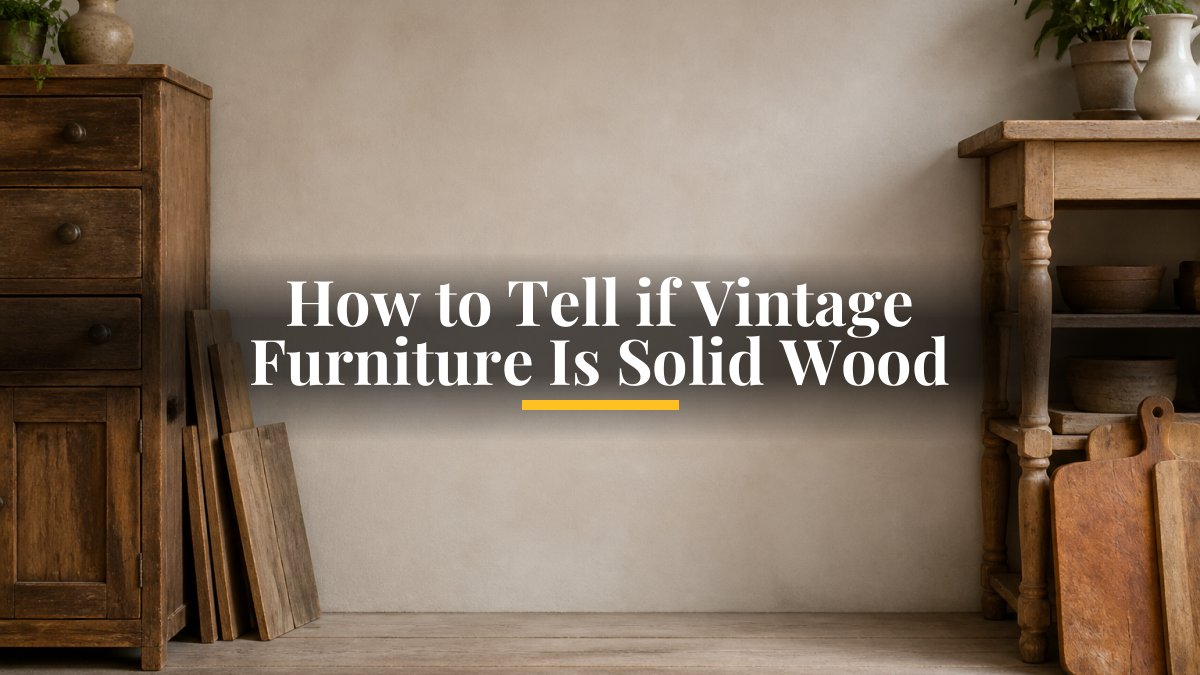
How to Tell if Vintage Furniture Is Solid Wood
Last Updated: October 26, 2026
Quick Summary
The fastest way to tell if vintage furniture is solid wood is to check the end grain and edges: solid wood shows continuous grain lines running through the full thickness of a board, while veneer shows a thin top layer over a different core. Tap large panels, compare drawer fronts for repeating grain, and lift a corner to feel the density.
- End grain on solid wood shows growth rings and pores continuing straight through the board.
- Veneer is real wood sliced thin, so grain pattern alone cannot prove a piece is solid wood.
- A piece can be solid wood in the frame and veneered on the panels, so check each surface separately.
- Hand-cut dovetails vary slightly while machine-cut ones are perfectly uniform, both can be good.
- Ask sellers for close-up photos of edges and corners before buying online.
Table of Contents
- Start With the End Grain and Edge Test
- Solid Wood vs Veneer Furniture: What the Difference Actually Looks Like
- How to Identify Wood Veneer Furniture Before You Buy
- Vintage Furniture Quality Signs That Go Beyond the Wood
- Why Grain Pattern Alone Won't Prove It's Solid Wood
- How to Identify Wood Types Used in Vintage Furniture
- Questions to Ask Before You Bring a Vintage Piece Home
- Frequently Asked Questions
Start With the End Grain and Edge Test
The fastest way to tell if vintage furniture is solid wood is to look at the end grain and the edges. Solid wood shows continuous grain lines running through the full thickness of a board. Veneer shows a thin top layer over a different core, and the giveaway is usually at the corners.
At JunQtique, we hear this question constantly from first-time buyers. It matters because the answer changes everything about how a piece will age, how it can be refinished, and whether it is worth bringing home. Below, we walk through the checks we use ourselves, in the order that saves the most time.
Solid wood is lumber cut from a single piece of timber through its full thickness. Veneer is a thin slice of real wood glued over a cheaper core, like plywood or particleboard.
Start with a flashlight and a close look at three spots:
- The end grain on a tabletop edge or chair leg
- The corner where two boards meet
- The underside of a top or seat
What the End Grain Tells You
End grain is the cut face at the end of a board. On solid wood it shows growth rings, pores, and grain lines that continue straight through. On veneered pieces, the end often shows a thin dark line where the veneer sheet stops and the core begins.
Run your fingernail across the end. Solid wood feels like one continuous surface. Veneer can catch slightly at the seam.
Reading the Edges and Corners
Corners are where veneer gives itself away. Look for a repeating grain pattern across a wide flat surface. Real wood rarely repeats; veneer cut from the same flitch often does.
Check the corner joints too. Solid wood boards usually show end grain at a miter or butt joint. A perfectly uniform edge with no visible grain at the corner is a hint that a veneer sheet wraps around it.
Solid Wood vs Veneer Furniture: What the Difference Actually Looks Like
Solid wood vs veneer furniture looks different up close in three specific ways: the grain carries through the thickness, the edges show end grain, and the surface does not repeat. Veneer shows a thin top layer, a visible seam at edges, and sometimes a mirrored grain pattern across drawer fronts.
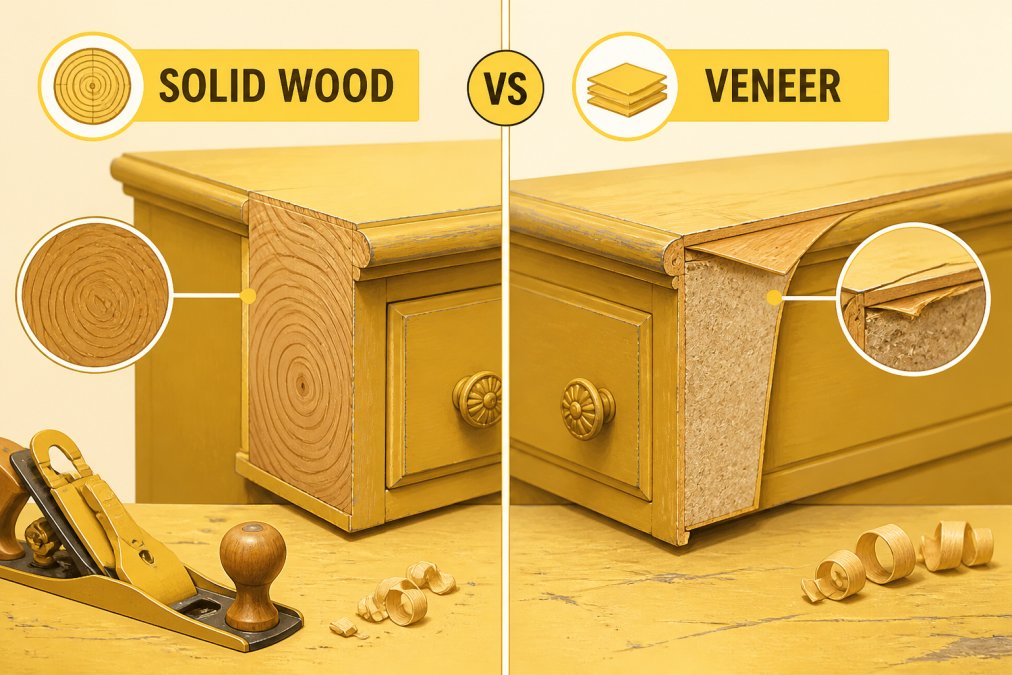
Here is what to look for in plain terms:
| What You See | Solid Wood | Veneer |
|---|---|---|
| End grain at edges | Continuous rings and pores | Thin line, then a different core |
| Grain on the surface | Unique, never repeats | Often repeats across panels |
| Weight | Heavier for its size | Lighter, sometimes hollow-sounding |
| Damage response | Dents and scratches | Chips and peels at edges |
Veneer is not automatically bad. Plenty of fine antique pieces use veneer over solid wood for decorative effect. But if you are buying for durability and refinishing potential, solid wood is the safer bet.
How to Identify Wood Veneer Furniture Before You Buy
You can identify wood veneer furniture before you buy by checking four things: the edge seam, the grain repetition, the sound when tapped, and the weight. Any one of these alone is a hint; two or three together is a strong signal.
A common mistake is judging from photos alone. Grain repetition is much easier to spot in person, and a seller's listing photos rarely show the edges.
Try this sequence when you are standing in front of a piece:
- Tap the center of a large flat panel with your knuckles. A hollow, thin sound leans veneer.
- Look at the edge of a drawer front or tabletop for a seam line.
- Compare two drawer fronts side by side. Identical grain means veneer.
- Lift one corner if you can. Solid wood feels dense for its size.
Watch out: a piece can be solid wood in the frame and veneered on the panels. Many vintage dressers mix both. Check each surface separately rather than judging the whole piece from one spot.
Vintage Furniture Quality Signs That Go Beyond the Wood
Vintage furniture quality signs go beyond the wood itself: joinery, hardware, drawer construction, and the finish all tell you how well a piece was built. A solid wood top on a wobbly frame is still a wobbly piece.
Look for dovetail joints on drawer corners. Hand-cut dovetails vary slightly; machine-cut ones are perfectly uniform. Both can be good, but hand-cut usually signals an older, higher-effort build.
Check the hardware. Original brass pulls that sit flush and operate smoothly suggest a piece that was cared for. Rusted, mismatched screws are a sign of later repairs.
Slide every drawer and open every door. Drawers should glide without forcing. A drawer that sticks usually means swollen wood or a warped runner.
If you have confirmed a piece is solid wood and want to bring it back to life, our vintage furniture restoration tips for beginners walk through the first steps.
Why Grain Pattern Alone Won't Prove It's Solid Wood
Grain pattern alone will not prove a piece is solid wood because veneer is real wood too. A veneer sheet is sliced from actual timber, so it has genuine grain. The pattern looks real because it is real; it is just thin.
This is the part most guides get wrong. They tell you to "look for wood grain" as if veneer were printed plastic. Modern veneer, and most vintage veneer, is authentic wood.
So what actually separates them? Thickness and continuity. Solid wood has grain running through the full depth of the board. Veneer has grain only in the top fraction of a millimeter.
Here is a quick way to remember it: grain proves the surface is wood; the edge proves the whole board is wood.
How to Identify Wood Types Used in Vintage Furniture
You can identify wood types in vintage furniture by color, grain texture, and pore pattern. Oak shows prominent open pores and ray flecks. Mahogany has a deep reddish-brown tone with a fine, straight grain. Walnut runs from chocolate to purplish-brown with a wavy figure. Maple is pale and tight-grained with little visible pore structure.
A few common vintage woods and their tells:
- Oak: heavy, open grain, often quarter-sawn with visible flecks
- Mahogany: rich red-brown, smooth, resists dents well
- Walnut: dark and warm, swirls and waves in the grain
- Maple: light and hard, subtle grain, often used for tables and dressers
- Pine: soft, knotty, yellows with age, dents easily
Bring a small magnifier if you are serious about identification. Pore size and arrangement are the clearest signals, and they are hard to fake. The U.S. Forest Service wood identification guide is a solid free reference for matching a sample to a species.
Questions to Ask Before You Bring a Vintage Piece Home
Ask the seller direct questions before you commit: what the piece is made of, whether any panels are veneered, how the joints are built, and whether it has been repaired. A seller who cannot answer is not necessarily hiding something, but a clear answer builds trust.
Our short list:
- Is the top solid or veneered?
- Have any drawers or joints been repaired?
- Does it wobble, and where?
- Are the hardware and finish original?
- Can you send a close-up of the edges and corners?
Seeing a real example helps. A 1946 antique buffet shows what a quality vintage piece looks like up close, and a one-of-a-kind antique cabinet is the kind of distinctive find worth asking careful questions about.
Watch out: online listings that only show styled wide shots are the hardest to judge. Always ask for edge and corner photos before you buy.
Frequently Asked Questions
How can you tell the difference between solid wood and veneer?
Look at the end grain and edges. Solid wood shows continuous grain running through the board's thickness, including the cut ends. Veneer furniture has a thin top layer over a core of plywood or particleboard, so the edge grain looks different from the face grain, and you may spot a seam or a repeating pattern. Tapping the surface also helps: solid wood sounds dense and consistent, while veneer over a hollow core can sound flatter. Check drawer sides and the underside too, since those areas are rarely covered up.
Does a wood grain pattern prove that furniture is solid wood?
No. Veneer is real wood sliced thin, so it carries a genuine grain pattern that can fool you at a glance. The giveaway is repetition: veneered panels often show the same grain motif mirrored across a drawer front or tabletop because the slices come from the same log. Solid wood shows grain that runs continuously and differently on every face, including the edges and ends. Always check the end grain and the underside before trusting the surface pattern.
Can a piece of furniture have both solid wood and veneer?
Yes, and many vintage pieces do. It is common for a dresser to have a solid wood frame, legs, and drawer sides with veneered panels on the top and drawer fronts. That construction is not a flaw; it is how makers got a stable, flat surface with an attractive face. When you assess vintage furniture quality signs, judge the structural parts separately from the decorative panels. Solid joinery and heavy, straight legs matter more than whether every surface is solid.
What should you ask a seller about a vintage wood furniture piece?
Ask what the piece is made of, whether any panels are veneered, and whether there are repairs, splits, or water rings. Request close-up photos of the end grain, the drawer sides, and the underside, since those show construction honestly. Ask about the joinery (dovetails, mortise and tenon) and whether the piece has been refinished. If you are buying online, confirm the return policy and how the item is packed for shipping before you commit.
Knowing what to look for turns a gamble into a confident buy. At JunQtique, we curate vintage treasures and bespoke furniture so you can skip the guesswork and start with pieces worth keeping. Our collection pairs one-of-a-kind finds with professional-grade Chalk Paint® supplies, so the piece you bring home is ready for its next chapter. Get started with JunQtique and find something truly beautiful to bring into your space.