 blog
7 Bespoke Furniture Pieces That Transform Small Spaces
Last Updated: November 2, 2026
Quick Summary
You buy bespoke furniture for small spaces by measuring your room's exact dimensions and commissioning pieces built to fit them, from wall length at three heights to door swings and delivery route. Custom-built pieces use the space stock furniture wastes, and JunQtique's bespoke furniture collection lets you start that conversation.
- Measure wall length at baseboard, midline and ceiling line, since old walls bow.
- The most common custom furniture failure is improper scaling from rushed measurements.
- Tables and desks are projected to account for 18% of growth in the small space category.
- Ask for a dimensioned drawing and written spec before you commit to a build.
- Structural bespoke work with hidden storage or wall attachment belongs with a professional.
Table of Contents
- Why Bespoke Furniture Beats Off-the-Shelf for Small Spaces
- Custom Furniture for Small Spaces: Measuring for a Perfect Fit
- Space-Saving Furniture Ideas That Maximize Every Inch
- Multifunctional Furniture for Small Spaces: One Piece, Two Jobs
- Your Custom Furniture Buying Guide: From Sketch to Delivery
- Ergonomics, Materials, and Longevity in Compact Pieces
- Start Your Bespoke Furniture Project with JunQtique
- Frequently Asked Questions
Why Bespoke Furniture Beats Off-the-Shelf for Small Spaces
The small space furniture market is projected to grow from USD 7,095 million in 2026 to USD 12,948 million by 2036, according to Future Market Insights' small space furniture forecast.
Off-the-shelf pieces are built to average dimensions. A sofa sized for a 12-foot wall crowds a 9-foot one. A stock bookshelf leaves a dead gap beside the door.
Bespoke furniture is furniture designed and built to your room's exact dimensions, proportions, and use patterns rather than to a manufacturer's standard sizing.
The numbers back the demand. The custom furniture market is valued at USD 44.76 billion in 2026, per Business Research Insights' custom furniture market report, and a separate estimate from Coherent Market Insights puts the global custom furniture market at USD 38.78 billion in 2026.
Here is what most guides get wrong. They treat "small space" as a style, all pale wood and folding legs. It is not a style.
Below, we walk through the pieces that earn their footprint, how to measure before you order, and where DIY ends and professional bespoke joinery begins.
Here are the market figures the article cites for small space and custom furniture.
| Item | Value | Note |
|---|---|---|
| Small space furniture market, 2026 | USD 7,095 million | Projected to reach USD 12,948 million by 2036 |
| Small space furniture market, 2036 | USD 12,948 million | Future Market Insights forecast |
| Custom furniture market, 2026 | USD 44.76 billion | Business Research Insights estimate |
| Custom furniture market, 2026 | USD 38.78 billion | Coherent Market Insights estimate |
Custom Furniture for Small Spaces: Measuring for a Perfect Fit
Custom furniture for small spaces lives or dies on the tape measure. A 2024 study in ResearchGate's analysis of small space interior design challenges found that optimizing compact rooms depends on chair efficiency and furniture footprint, meaning the physical space each piece claims and how well it works within it. Get the numbers wrong and even a beautiful piece becomes an obstacle.
What to Measure Before You Order
Measure more than the wall. Measure the path.
- Wall length, at three heights. Baseboard, midline, and ceiling line. Old walls bow.
- Door and window swing. A door that opens 90 degrees needs that arc kept clear.
- Walkway width. Leave enough room for a person to pass comfortably beside the piece.
- Ceiling height and any sloped sections. Attic rooms and dormers change what fits.
- Outlet and radiator positions. A desk or cabinet that blocks them is a problem you will live with daily.
- Delivery route. Hallway width, stair turns, and elevator dimensions. A piece that fits the room but not the stairwell is a refund waiting to happen.
Watch out: the most common custom furniture failure is improper scaling, where a piece arrives too large or too small because the initial measurements and spatial planning were rushed. Measure twice, and sketch the floor plan with the piece drawn to scale before you commit.
Space-Saving Furniture Ideas That Maximize Every Inch
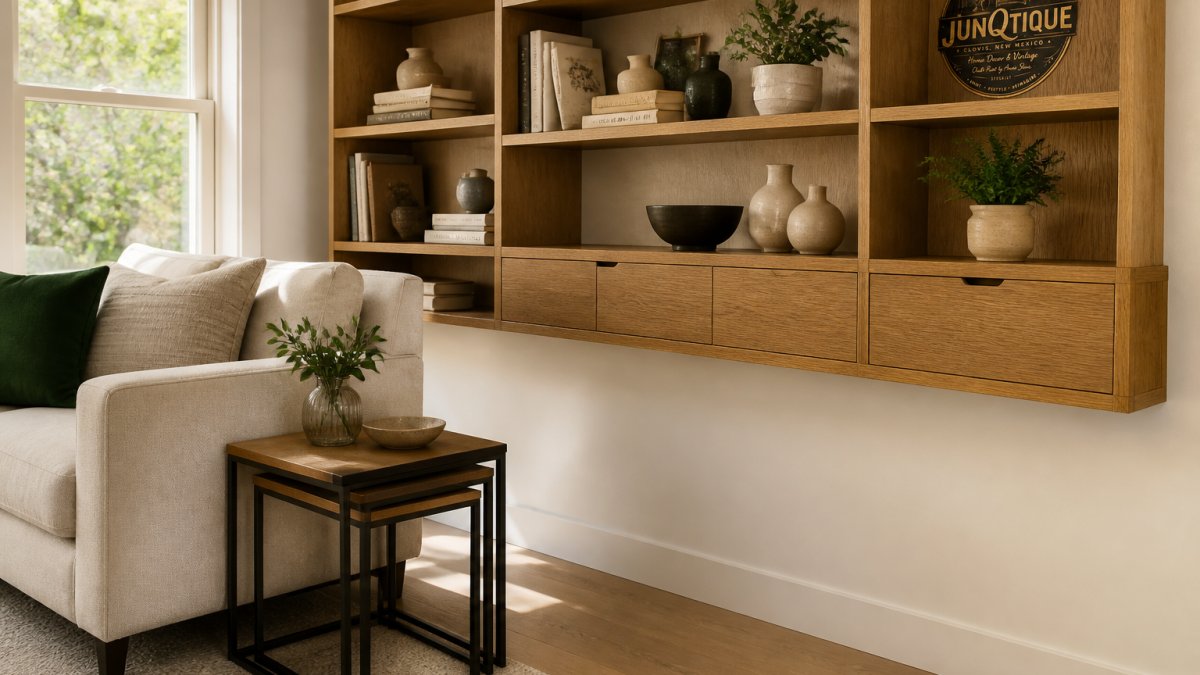
Space-saving furniture ideas work best when they follow one rule: build upward and inward, not outward. Vertical storage and wall-mounted solutions keep the floor clear, which is what makes a compact room feel open rather than cramped. But the ideas only pay off when they are sized to your actual walls, a stock floating shelf that stops two inches short of a corner gives back the space it was supposed to save.
Vertical Storage and Wall-Mounted Solutions
Wall-mounted shelving, floating cabinets, and full-height built-ins turn unused wall area into functional footprint. A custom-built unit can run floor to ceiling and wrap a corner exactly, leaving no wasted gap. Multifunctional pieces like storage ottomans and extendable tables are a core part of compact design, and vertical storage belongs in that same toolkit.
The bespoke advantage here is depth control. Stock wall cabinets can feel punishing over a desk or a sofa. A custom unit can be specified at 9 or 10 inches for books and display, keeping the walkway clear while still holding what you need.
Seating, Tables, and Pieces That Disappear
Nesting tables, fold-down desks, and modular shelving all share one trait: they collapse or stack when not in use. The piece does two jobs, or it disappears. That is layout efficiency in practice.
Seating is where the trade-offs get real. A nesting side table set gives you a surface for a lamp and a surface for a guest, then collapses to a single footprint.
Watch out: the most common space-saving mistake is buying a piece that saves floor area but blocks the walkway or a door swing. Sketch the open and closed positions on your floor plan before you commit, and confirm the piece still leaves a clear path beside it.
Why Bespoke Beats Stock in This Category
Stock space-savers are built to average dimensions, so they save space in the abstract and waste it in your room. A custom nesting table can be sized to tuck under a specific sofa arm; a custom fold-down desk can be built to clear a radiator and land at the exact height your chair needs. The category is crowded with ideas, the bespoke angle is making each idea fit the millimeter.
Multifunctional Furniture for Small Spaces: One Piece, Two Jobs
Multifunctional furniture for small spaces solves the central compact-room problem: you need the function of five rooms in two. A sleeper sofa replaces a guest bed. A storage ottoman replaces a coffee table and a blanket chest. An extendable table seats two on a normal night and six at Thanksgiving.
The market reflects the shift. Tables and desks are projected to account for 18% of growth in the small space furniture category, according to OpenPR's segment analysis. Convertible and nesting designs are where the demand is heading.
What most guides miss is that multifunctional does not mean flimsy. A sleeper sofa built to custom dimensions with proper frame construction outperforms a stock convertible that wobbles after a year. The mechanism matters as much as the concept.
Your Custom Furniture Buying Guide: From Sketch to Delivery
A custom furniture buying guide should start with a warning: the process is a conversation, not a checkout.
- Consultation. Share your room dimensions, photos, and how you will use the piece. Bring the measurement list from the section above, wall lengths at three heights, door and window swings, walkway width, and the delivery route.
- Design and sketch. You review proportions, materials, and finish options. Ask for a dimensioned drawing so the build matches your room.
- Quote and deposit. Pricing depends on quantity, dates, and delivery, so request a current quote from JunQtique's website.
- Build. The workshop constructs your piece to the agreed spec. Ask for a progress photo at the frame stage, before finish is applied.
- Delivery and placement. Confirm the delivery route in advance, including stair turns and elevator dimensions, and confirm who is responsible for placement and any wall attachment.
DIY vs. Professional Bespoke: A Cost-Benefit View
The DIY-versus-professional question is where most guides stop at "it depends." A clearer way to decide is to separate the work into three buckets.
- Refinishing and repainting. This is the strongest DIY territory, and it is where a quality chalk paint earns its place. Annie Sloan Chalk Paint® is built for exactly this use, and it is the lower-friction choice for a piece you are keeping.
- Small modifications. Adding a shelf, swapping hardware, or building a simple box cushion is reasonable DIY work if you have the tools and the patience. The risk is dimensional: a shelf cut a quarter-inch short is a visible gap.
- Structural bespoke. A built-in that must meet a wall exactly, a piece with hidden storage, or furniture that carries weight belongs with a professional. The joinery, the wall attachment, and the load path are not places to learn on the job.
The cost-benefit math is not only about the quote. A professional piece that fits the room exactly and can be repaired rather than replaced usually costs less over its life than two or three stock pieces that never quite work. A DIY refinish on a piece you already own is the cheapest way to change a room's look without changing its footprint.
What to Ask Before You Commission
Ask how the maker handles custom dimensions and whether they provide a dimensioned drawing before build. Ask what joinery they use at the load-bearing points, and whether the finish is applied in the workshop or on site. Ask for the delivery route plan in writing. Luce et Studio, for example, delivered an original custom-fitted solution for a West Chelsea residence by working directly from the space's constraints, as reported by Residential Design Magazine. That is the standard to expect: design driven by the room, not the catalog.
Watch out: the most common commissioning failure is a verbal spec. If the drawing, the dimensions, and the finish are not written down and signed off, the finished piece can be "correct" and still wrong for your room.
Ergonomics, Materials, and Longevity in Compact Pieces
Ergonomics matter more in small rooms, not less. A compact desk still needs the right height for your chair and screen. A bench used daily needs a seat depth that supports your legs. Custom dimensions let you set these numbers deliberately instead of accepting whatever a stock size offers.
Material choice drives longevity. Solid wood frames outlast particleboard, and a well-joined piece can be repaired rather than replaced. If you want to judge construction quality before you buy, our guide on how to tell if vintage furniture is solid wood walks through the checks.
Maintenance keeps a custom piece working for years. Tighten joints annually, keep wood out of direct sun, and address wobbles early.
Start Your Bespoke Furniture Project with JunQtique
The challenge with small spaces is that no two are alike, and standard furniture was never built for yours. JunQtique curates vintage treasures, bespoke furniture, and home decor, and we stock professional-grade Chalk Paint® supplies so you can finish or refresh a piece yourself. If you are ready to commission something made for your room, browse our bespoke furniture collection and start the conversation. Get started with JunQtique and furnish the space you actually have.
Frequently Asked Questions
Is bespoke furniture worth it for a small space?
For rooms with awkward dimensions or non-standard walls, bespoke furniture often delivers more usable space than ready-made pieces. Custom-built designs fit exact measurements, so you avoid gaps and wasted corners. The key is measuring carefully first, since poor scaling can leave a custom piece too large or too small for the room.
What should I measure before ordering custom furniture for small spaces?
Measure the full floor plan, including doorways, window heights, and any radiators or outlets. Note ceiling height and the swing path of doors and drawers. Also record the diagonal depth of the room, since a piece that fits wall-to-wall may not fit through the entry. Bring these numbers to your maker so the custom dimensions account for clearance, not just the footprint.
Can bespoke furniture be made to fit an awkward space?
Yes. Custom-built pieces are designed around sloped ceilings, alcoves, and narrow walls that standard furniture cannot fill.
How do I choose multifunctional furniture for small spaces?
Prioritize pieces that serve two or three daily functions, such as a storage ottoman, a sleeper sofa, or an extendable table. Check that the conversion mechanism is simple enough to use every day, not just occasionally. Look for hidden storage that keeps clutter-free surfaces, and confirm the piece still fits your floor plan when fully extended. A good rule is to buy multifunctional only when both functions get regular use.