 listicle
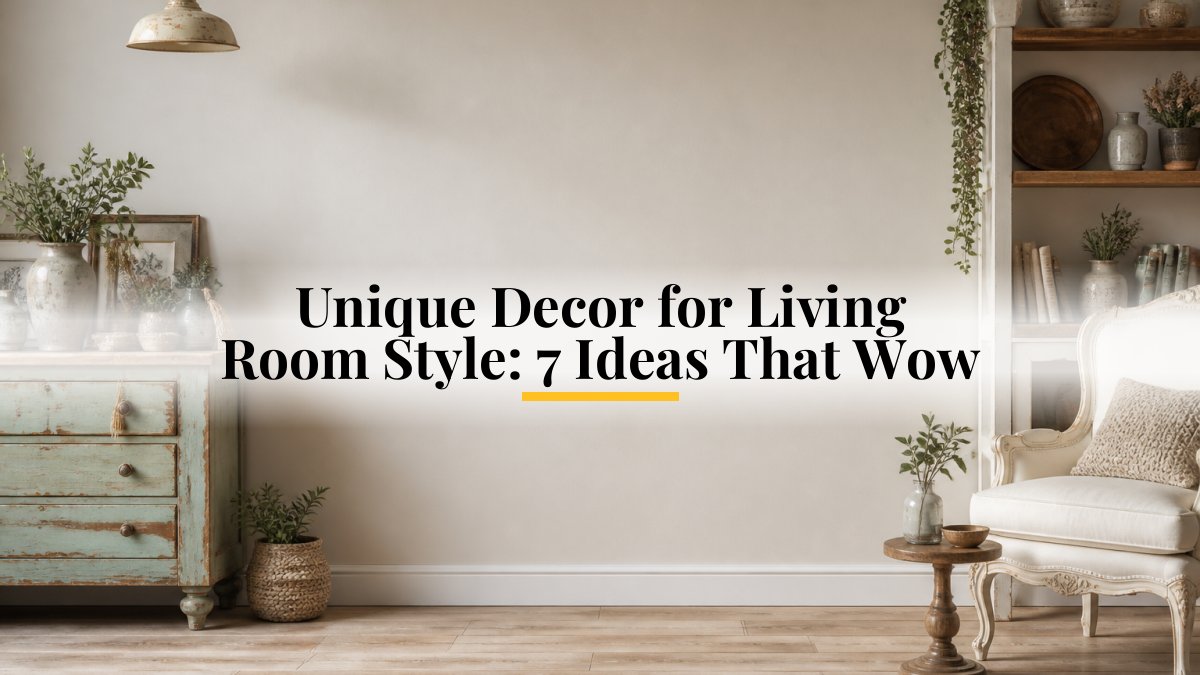
Unique Decor for Living Room Style: 7 Ideas That Wow
Table of Contents
- Why Unique Decor Transforms a Living Room
- Unique Living Room Decor Ideas That Start Conversations
- Living Room Wall Decor Ideas for a Focal Point
- Vintage Living Room Decor: Mixing Old and New
- Living Room Shelf Styling with Collected Objects
- Sustainable and Budget-Friendly Ways to Add Unique Decor
- Small-Space and Psychology-Driven Decor Choices
- Frequently Asked Questions
Last Updated: October 21, 2026
Why Unique Decor Transforms a Living Room
Unique decor for living room style works because it gives the eye somewhere to land. A room full of matching sets reads as furniture storage; a room with one sculptural lamp, an odd-shaped vase, and a rug with a story reads as a home. At JunQtique, we see this play out constantly with customers who start with one vintage find and end up restyling the whole room around it.
The psychology is simple. A focal point tells the brain where to rest, and everything around it organizes itself. Designers call this spatial planning; you can call it giving the room a spine. Below, we'll show you exactly how to build that spine with seven ideas, plus the budget and small-space workarounds most guides skip.
But first, here's what most guides get wrong: they treat unique decor as shopping. It isn't. It's editing.
Unique Living Room Decor Ideas That Start Conversations
Unique living room decor ideas share one trait: they invite a question. A hand-thrown ceramic vessel, a salvaged wood console, a lamp that looks like it belongs in a gallery. These pieces do the talking so you don't have to.
Start with sculptural accents and statement objects. Think curved vases, chunky candleholders, abstract forms in stone or clay. Group them in odd numbers on a coffee table or console. A common mistake is spreading small objects evenly across every surface. Cluster them instead, and leave empty space around the cluster.
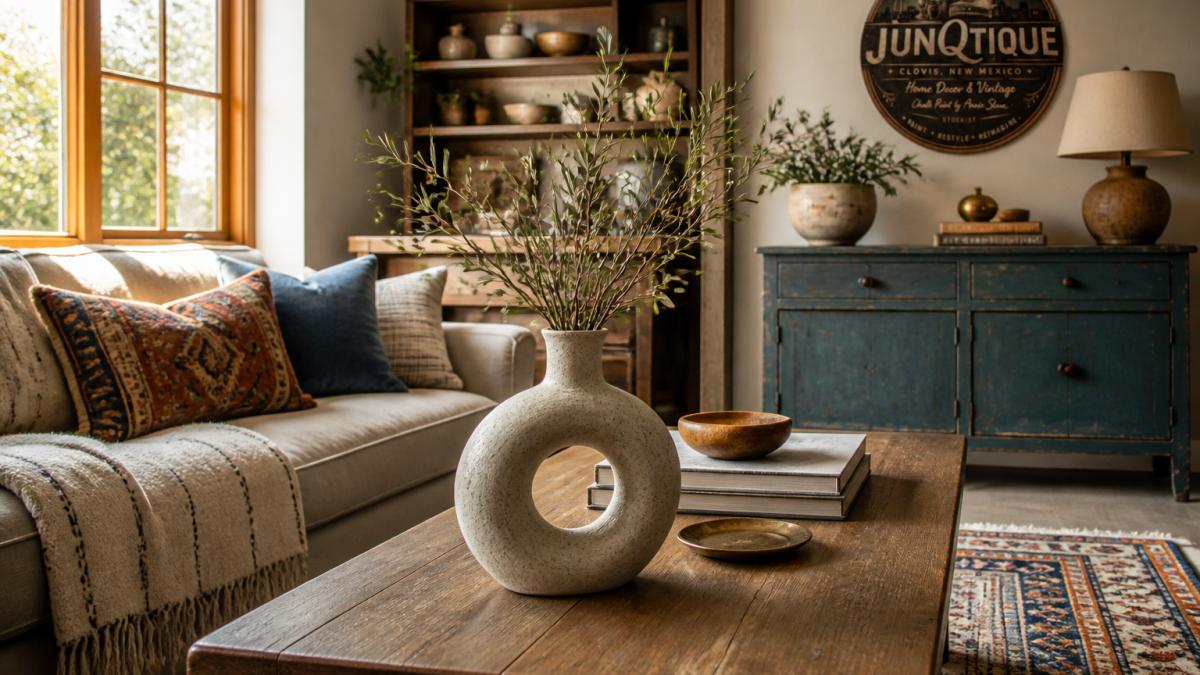
Textiles, rugs, and layered texture carry the rest. Layer a vintage rug over a neutral jute base, add a nubby throw, then a smooth linen cushion. Three textures in one seating area is the sweet spot. The contrast is what reads as curated rather than catalog-ordered.
Living Room Wall Decor Ideas for a Focal Point
Living room wall decor ideas live or die on arrangement, and arrangement is where most rooms go wrong. A gallery wall works when you plan the layout on the floor first, cut paper templates to size, and tape them up before driving a single nail. Keep gaps consistent, most designers land on 2 to 3 inches between frames, mix frame sizes, and anchor the whole group to one invisible centerline so the eye reads it as a single composition rather than a scatter of pictures.
Hang height matters more than most people expect. The common guideline is to center the arrangement at roughly 57 inches from the floor, which puts the middle of the group at average eye level. Above a sofa, leave 6 to 8 inches of breathing room between the seat back and the bottom frame; hang too high and the art floats away from the furniture it's meant to anchor.
Art arrangements should feel collected, not purchased in one trip. Start with one piece you love, then build outward over months. Mix originals with prints, and don't match every frame. A little mismatch signals authenticity, a uniform set of identical frames from one store reads as a kit, not a collection.
Statement lighting is the most overlooked wall-adjacent decor. A sculptural pendant or an oversized floor lamp does more for a room than another framed print, because it changes the light in the room rather than just filling a surface. Pair it with window treatments that frame rather than cover: relaxed linen panels hung high and wide make ceilings feel taller. Mount the rod 4 to 6 inches below the ceiling or crown molding, and extend it 6 to 12 inches past each side of the window so the panels hang over wall, not glass, that single move is what makes a standard window read as a feature.
| Element | What It Does | Where to Place It |
|---|---|---|
| Gallery wall | Creates a focal point | Largest blank wall, centered near 57 inches |
| Statement lamp | Adds sculptural interest | Corner or beside seating |
| Layered curtains | Softens light, adds height | Flanking main window, rod 4-6 inches below ceiling |
| Sculptural mirror | Bounces light, adds depth | Opposite the window |
A note on the psychology angle most guides skip: a focal wall gives the eye a place to rest, and rooms without one feel restless even when every individual object is attractive. Decide which wall is the focal wall before you buy anything, and let the other three walls stay quieter. That single decision does more for a room's calm than any individual purchase.
Vintage Living Room Decor: Mixing Old and New
Vintage living room decor succeeds when the old pieces look intentional, not accidental. The rule we follow: one vintage anchor per zone, surrounded by modern or neutral pieces. A mid-century credenza against a clean white wall. A farmhouse bench under a minimalist print.
Mixing eras works best when you repeat one thread: a color, a wood tone, or a metal finish. Without that thread, a room reads as a flea market. With it, it reads as bespoke.
Living Room Shelf Styling with Collected Objects
Living room shelf styling is where collected objects earn their keep, and it's also where most people stall. The formula that works: books stacked horizontally, one vertical row for height, a sculptural object, and something living. Repeat that rhythm across each shelf, varying the proportions so no two shelves look identical, identical shelves read as a showroom, varied ones read as a life.
Leave roughly a third of each shelf empty. Crowded shelves hide the pieces you love, and negative space is what makes a single object look intentional rather than stored. Group by theme, not by color: travel finds together, ceramics together, vintage glass together. Color-grouped shelves photograph well but stop meaning anything after a week.
A few mechanics that separate styled shelves from decorated ones:
- Vary the depth. Pull a few objects forward and push others back. A flat plane of objects at the same depth reads as a display case.
- Stack books in odd numbers and top the stack with one object, not three. A stack of two or four looks unresolved.
- Mix heights within a shelf, a tall vase beside a low bowl beside a horizontal book stack gives the eye a staircase to follow.
- Anchor with one heavy piece per bay. A large ceramic or a stone bookend keeps a shelf from floating.
Budget and small-space workarounds. Shelf styling is one of the cheapest ways to add unique decor because it rewards what you already own. Shop your own home first, a vase from the bedroom, a bowl from the kitchen, a stack of books from the office. Rotate objects seasonally rather than buying new ones; the rotation itself is the refresh. For small rooms, go vertical with shelving and keep the bottom two shelves for closed storage so the eye stays on the styled upper shelves. A single tall bookcase styled well does more for a small living room than three short ones styled thinly.
The psychology piece. Shelves are the most-read surface in a living room because they sit at eye level and invite close inspection. Objects that carry a story, a rock from a trip, a hand-thrown mug from a local potter, a book someone actually read, read as personality. Objects bought to fill a gap read as filler. The test: if you can't say where a piece came from in one sentence, it probably belongs in a drawer, not on the shelf.
Sustainable and Budget-Friendly Ways to Add Unique Decor
The most unique decor is often the least expensive. Thrift stores, estate sales, and marketplace listings turn up one-of-a-kind pieces no retailer stocks. Look for solid wood, real brass, and hand-thrown ceramics; those materials age well and hold value.
Another route: make your own statement. A tired piece of furniture refinished in Chalk Paint® becomes a focal point for a fraction of replacement cost, and the finish is forgiving for beginners.
Small-Space and Psychology-Driven Decor Choices
Small rooms benefit most from bold choices. A single oversized artwork makes a small living room feel intentional; five small frames make it feel cluttered. Go vertical with shelving and lighting to draw the eye up, and choose multi-use pieces like a storage ottoman that doubles as a coffee table.
The psychology piece is real. Warm textures and rounded shapes read as cozy; hard edges and cool tones read as formal. Decide how you want the room to feel before you buy a single object, and let that decision filter every choice.
A living room that feels uniquely yours doesn't require a designer or a big budget. It requires one strong focal point, a willingness to mix eras and textures, and the patience to collect rather than buy everything at once. At JunQtique, we curate vintage treasures, bespoke furniture, and unique home decor alongside professional-grade Chalk Paint® supplies, so you can find the one-of-a-kind piece and the tools to make it yours. Browse our collection and start with a single object that makes you smile.
Frequently Asked Questions
How can I make my living room decor look unique?
Start with one statement piece that reflects your personality, like a vintage find or a sculptural object. Build around it with layered textures and a consistent color palette. Mix eras and styles rather than buying a matching set, and use personal collections as decor. Focus on creating a focal point, then let the rest of the room support it without competing for attention.
How do I mix vintage and modern decor in a living room?
Balance is key. Pair a vintage rug or an antique cabinet with clean-lined modern furniture to keep the look fresh. Use a unifying color palette to tie different eras together, and repeat materials or finishes to create cohesion. Limit vintage pieces to two or three per room so they stand out as accents rather than clutter, and keep the overall aesthetic intentional.
How can I style shelves with collected objects?
Group objects in odd numbers and vary heights for visual interest. Mix books, ceramics, and personal treasures, but leave some empty space so the display breathes. Use a consistent color story or material theme to avoid a cluttered look. Start with larger pieces as anchors, then fill in with smaller items, and edit regularly to keep the arrangement fresh.
What wall decor works well in a living room?
A large-scale art piece or a gallery wall arrangement can serve as a focal point. Consider a mix of framed prints, mirrors, and sculptural wall hangings to add depth. For a cohesive look, choose a color palette that complements your furnishings, and hang pieces at eye level. Don't be afraid to lean a large artwork on a console for a relaxed, curated feel.