 ultimate-guide
Chalk Paint by Annie Sloan: Colors, Finishes & Buying Guide
Table of Contents
- Why Chalk Paint by Annie Sloan Belongs in Your Next Project
- Annie Sloan Chalk Paint Colors: A Palette Built for Inspiration
- How to Mix Annie Sloan Chalk Paint Colors for Custom Tones
- Annie Sloan Chalk Paint Finishes: Wax, Lacquer, and More
- A Step-by-Step Approach to Painting Furniture with Chalk Paint
- Where to Buy Annie Sloan Chalk Paint Near New Mexico and Amarillo
- Conclusion
- Frequently Asked Questions
Last Updated: October 18, 2026
Why Chalk Paint by Annie Sloan Belongs in Your Next Project
Chalk Paint by Annie Sloan is a decorative furniture paint invented by British artist Annie Sloan in 1990, formulated to adhere to most surfaces without sanding or priming (What is Chalk Paint®?). At JunQtique, we stock the full line because it solves the problem that stops most DIY projects before they start: the fear of doing it wrong.
That fear is legitimate. Chalk Paint changes that equation. The paint formula was designed for furniture, cabinets, floors, and home decor, and it dries to a matte, velvety finish that takes wax beautifully.
Here is what most guides get wrong: they treat Chalk Paint as a shortcut product. It is not a shortcut. It is a different approach, one that rewards technique over brute force.
Annie Sloan Chalk Paint Colors: A Palette Built for Inspiration
The Annie Sloan Chalk Paint colors range covers more than 40 shades, from soft neutrals to saturated jewel tones, all built on the same opaque formula. The range is organized so that colors layer and blend well together, which is why interior design professionals use it for everything from a single accent piece to a whole-room scheme.
Signature Shades That Anchor a Room
Some colors do more work than others. Athenian Black is a deep black that reads as sophisticated rather than flat, and it works on ceramics, metal, and wood alike. Arles is a rich yellow with an earthy undertone that suits farmhouse and cottage interiors. Old White remains the most versatile neutral in the collection, warm enough to pair with almost any color inspiration you bring to it.
For painted furniture, we recommend starting with one anchor color and one contrast. A dresser in Old White with Athenian Black hardware detail is a combination that never looks dated.
How to Mix Annie Sloan Chalk Paint Colors for Custom Tones
Mixing Annie Sloan Chalk Paint colors is straightforward because every shade shares the same base formula, so they blend predictably. Combine two colors in a clean container, stir thoroughly, and test on a scrap of similar material before applying to your piece.
A few working rules we share with customers:
- Mix more than you think you need. Color matching a second batch by eye is difficult.
- Keep a written record of your ratio, such as two parts Old White to one part Arles.
- Add the darker color to the lighter one gradually. It is easier to deepen a tone than to lighten it.
- Store leftover mixed paint in a sealed container and label it with the ratio.
Custom tones are where the product range really opens up. A muted sage, a dusty blush, a custom greige: all of these come from blending two or three existing colors rather than hunting for a shade that does not exist.
Annie Sloan Chalk Paint Finishes: Wax, Lacquer, and More
Annie Sloan Chalk Paint finishes determine how your piece looks and how well it holds up. The three main options are clear wax, dark wax, and lacquer, and each produces a distinctly different result. Most guides stop at naming them.
Clear wax protects the paint and leaves the matte, chalky texture intact. It is the default choice for most furniture and the easiest to apply.
Dark wax adds depth and an aged patina. It works best applied over a base of clear wax so you can control how much settles into the detail.
Lacquer gives a harder, more durable surface with a slight sheen, which suits kitchen cabinets and pieces that see daily handling.
Choosing a Finish That Matches Your Space
Match the finish to the traffic, not the trend. A low-traffic bedroom dresser is fine with clear wax. A kitchen island or a family dining table benefits from lacquer's durability. Dark wax belongs on pieces where you want character and visible age, such as a vintage find with carved detail.
| Finish | Look | Durability | Application | Best For |
|---|---|---|---|---|
| Clear wax | Matte, natural | Moderate | Thin layers, buff after setting | Dressers, side tables, decor |
| Dark wax | Aged, patinated | Moderate | Over clear wax, wipe back excess | Carved detail, vintage pieces |
| Lacquer | Soft sheen | High | Thin coats in a dust-free space | Cabinets, tables, high-traffic pieces |
A practical pattern many refinishers follow is to wax a piece, live with it for a few weeks, and then decide whether the sheen and protection are right before committing to lacquer on a higher-traffic item. Wax can be refreshed with another thin layer; lacquer is a one-way decision once cured.
Wax and lacquer are not interchangeable. Wax is reversible and easier to refresh; lacquer is harder and more permanent. Choose based on how much wear the piece will take, not on which one sounds more premium.
Keep a dedicated wax brush for clear wax and a separate one for dark wax. Mixing residue between the two muddies the clear finish and is difficult to correct once it has set into the paint.
A Step-by-Step Approach to Painting Furniture with Chalk Paint
Painting furniture with Chalk Paint follows a simple sequence: apply thin coats, let each dry, then finish. The paint is thick, so thin coats are essential. A heavy coat will look uneven and take far longer to cure. The steps below are the same ones we walk customers through at the Clovis store, with the details that separate a clean result from a streaky one.
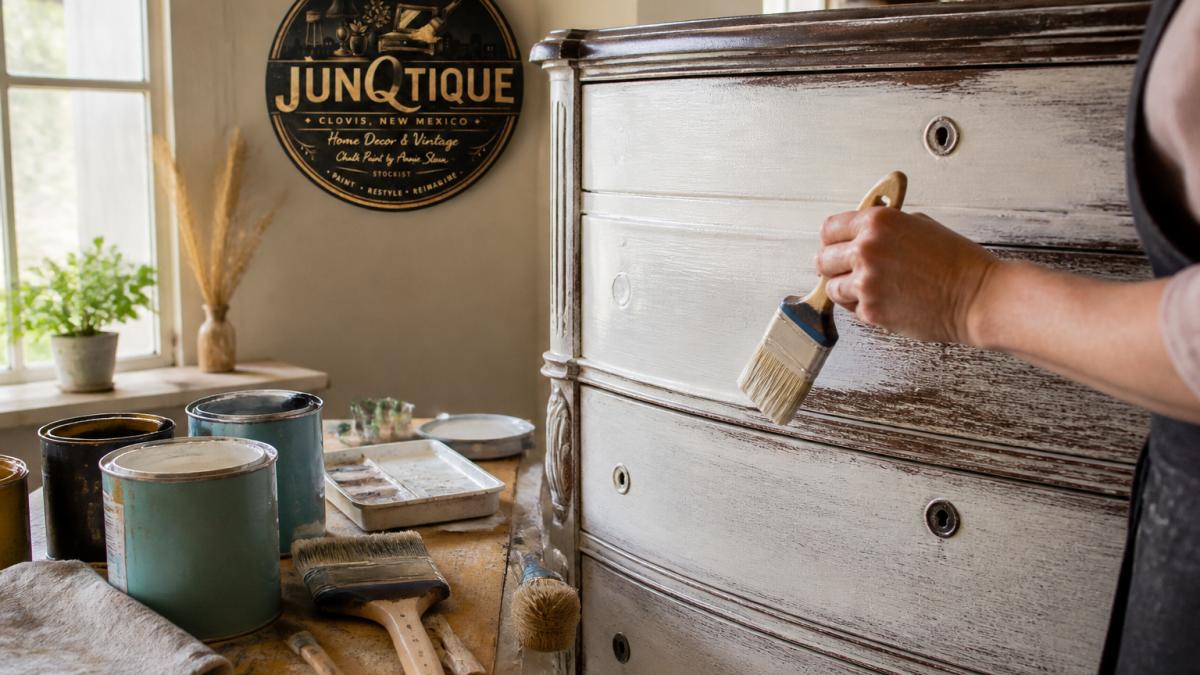
- Load the brush lightly. Dip only the tips of the bristles. Chalk Paint is thick, and an overloaded brush is the most common cause of drips and heavy texture.
- Apply the first coat in long, even strokes. Work in one direction where you can, and do not overwork the paint. The first coat is meant to look thin and slightly uneven; that is normal.
- Let it dry. Chalk Paint dries quickly, often within an hour depending on humidity. Cool, damp conditions stretch that time; warm, dry conditions shorten it. Test a corner with a light touch before recoating.
- Apply the second coat. A second thin coat gives full opacity and covers any thin spots. If a third is needed on a dark or heavily grained surface, apply it the same way: thin and even.
- Sand lightly if needed. A light pass with fine paper smooths brush texture before finishing. Wipe away dust before the finish goes on.
- Apply your chosen finish. Wax in thin layers, buffing between; or apply lacquer per its instructions.
- Let it cure. Avoid heavy use for several days while the finish hardens. Wax and lacquer both continue to set after they feel dry to the touch.
Coverage, Quantities, and Planning a Project
Coverage depends on the piece and how many coats you apply. As a general guide, a small side table needs far less paint than a full dresser, and the 4 oz size suits small projects while larger pieces call for a bigger paint size. A useful rule of thumb many refinishers use is to estimate the square footage of the visible surfaces, then add a margin for a second coat and touch-ups. Buy slightly more than you estimate rather than risk running short mid-project; a second batch mixed later is hard to match by eye.
Common Mistakes and How to Correct Them
Most problems with Chalk Paint trace back to application, not the product, and most are fixable before the finish goes on.
- Brush marks. Usually caused by overworking paint that has started to set. Once it begins to dry, leave it alone. Rebrushing partially dried paint creates drag marks that show through the finish. A light sand between coats smooths them out.
- Uneven coverage. Often a sign of a coat that was too heavy in one area and too thin in another. A second thin coat evens it out better than trying to fix the first.
- Bleed-through. Some woods release tannins or dye that show through light colors. A second coat usually covers it; if it persists, a third thin coat is the fix rather than a heavier one.
- Chipping after finishing. Almost always a finish problem, not a paint problem. Too little wax, wax applied too thick and left tacky, or lacquer applied over a dusty surface all weaken the top layer. Recoat thinly and buff.
A common mistake is brushing back over paint that has started to set. Once Chalk Paint begins to dry, leave it alone. Rebrushing partially dried paint creates drag marks that show through the finish.
Do not apply a finish over paint that is still soft to the touch. Wax and lacquer trap moisture and solvents underneath, and the piece can stay tacky or chip prematurely. Wait until the paint feels firm before finishing.
Where to Buy Annie Sloan Chalk Paint Near New Mexico and Amarillo
JunQtique is where to buy Annie Sloan Chalk Paint for customers across New Mexico and Amarillo, operating from our Clovis store.
Why buy from us rather than a general retailer? Three reasons. First, we stock the complete line, not a partial shelf of the most popular shades. Second, we use the paint ourselves on the bespoke furniture and vintage pieces we curate, so we can tell you how a specific color behaves on a specific surface.
For current availability and store pickup details, check our product pages or contact the Clovis store directly. For official product guidance and application instructions, the Annie Sloan official product information is a useful reference, and the American Coatings Association publishes general information on paint safety and disposal that is worth reviewing before any large project.
Conclusion
The hardest part of refinishing is starting, and the right paint removes most of that hesitation. Chalk Paint by Annie Sloan gives you a forgiving formula, a color range built for mixing, and finish options that suit everything from a bedroom dresser to a kitchen cabinet. We stock the full line at JunQtique because we believe the product earns its reputation, and because we would rather sell you the right supplies than the most supplies.
Browse our Chalk Paint collection, compare colors, and add your project essentials to cart, with store pickup available from our Clovis location for customers across New Mexico and Amarillo.
Frequently Asked Questions
Can I use Chalk Paint by Annie Sloan on furniture?
Yes. Chalk Paint by Annie Sloan is designed for furniture, cabinets, and home decor. It adheres to most surfaces without the need for sanding or priming, which makes it a favorite for DIY enthusiasts and experts alike. You can apply it directly to wood, metal, laminate, and more, then seal with wax or lacquer for durability. JunQtique carries the full product range to help you get started.
How do I mix Annie Sloan Chalk Paint colors?
Mixing Annie Sloan Chalk Paint colors is straightforward. Start with a base color and add small amounts of a second color, stirring thoroughly until you reach your desired shade. Keep notes on ratios so you can recreate the color later. You can also blend colors directly on the piece for a faux finish. Always test on a sample board first to see how the color dries.
Where can I buy Annie Sloan Chalk Paint near New Mexico or Amarillo?
JunQtique is your local source for Chalk Paint by Annie Sloan. We serve customers in New Mexico and Amarillo from our Clovis store. You can shop online or visit us to explore the full color range, finishes, and supplies. Our team is happy to help you choose the right products for your project.
What is the difference between Annie Sloan Chalk Paint and other paints?
Annie Sloan Chalk Paint is known for its versatility and ease of use. It requires no priming or sanding, dries quickly, and can be used on a wide range of surfaces. The formula is unique, allowing for various decorative finishes, from smooth modern looks to textured vintage styles. Other paints often need extra prep and multiple coats, but Chalk Paint by Annie Sloan simplifies the process.